Commodity exposure
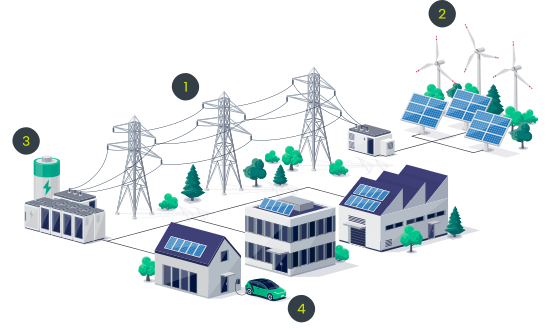
Markets aligned with four key thematics:
- Electrification
- Digitalisation and automation
- Security of supply
- Traditional economic growth
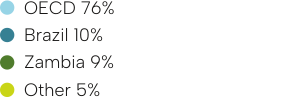
Geographic exposure
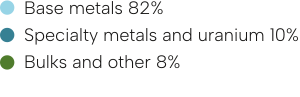
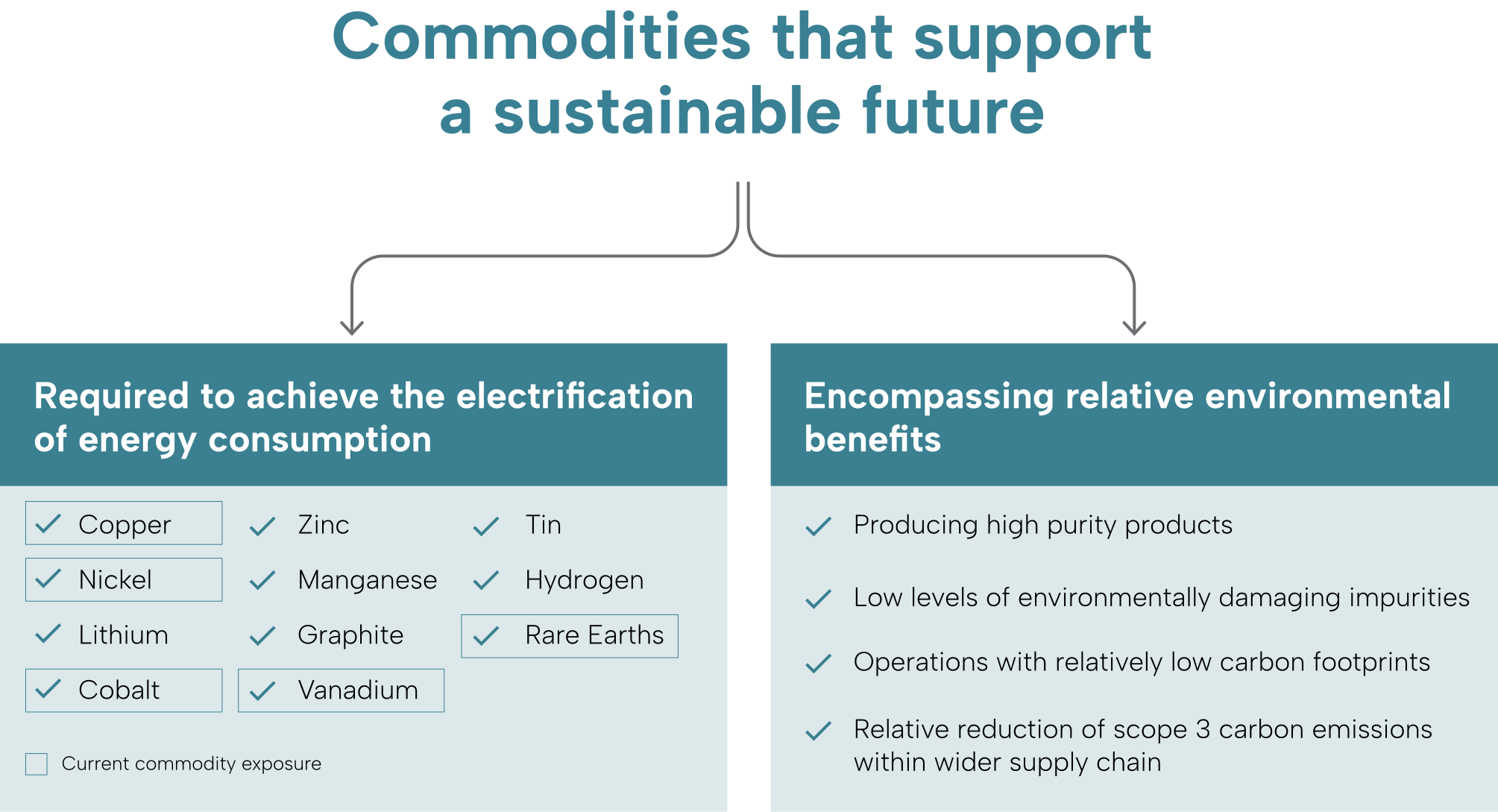
Commodity exposure
Stage of development
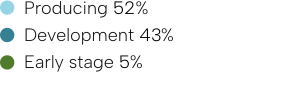
*Based on consensus sell side analyst NAV estimates as at 25 March 2026.
2025 - Overview of our markets
Base metals - Copper
LME copper prices entered 2025 between -$8,700-$9,000 per tonne and strengthened materially over the course of the year, despite the refined copper market running in surplus.
Chinese demand remained uneven, with persistent weakness in the property sector offset by resilience in grid investment, renewables, manufacturing and other energy- transition-linked uses. While electrification themes continued to underpin medium-term demand expectations, the physical market was not uniformly tight in aggregate terms.
Instead, 2025 was characterised by a pronounced disconnect between headline balances and price behaviour. Disruptions and underperformance at several large copper mines constrained concentrate availability and encouraged sentiment-driven buying, tightening conditions upstream and driving treatment and refining charges sharply lower, at times into negative territory. This occurred alongside ongoing smelter overcapacity, particularly in China, amplifying stress in the processing chain without translating into a broad refined metal shortage.
Market structure and trade flows played an increasingly important role as the year progressed. Anticipation of potential US trade measures encouraged the diversion of copper
units into the United States, widening COMEX–LME spreads and creating regional tightness outside the U.S. This reallocation reduced deliverable availability on the LME and SHFE, even as global availability remained adequate.
Financial conditions further amplified these dynamics. A weaker US dollar, a broadly supportive macro backdrop and heightened investor interest in electrification, AI and data-centre infrastructure supported speculative positioning and helped propel copper prices to record highs by late 2025, underscoring the extent to which price action was driven by flows, positioning and inventory location rather than refined supply-demand fundamentals.
Base Metals - Cobalt
In early 2025 the cobalt market faced subdued conditions, with Fastmarkets alloy-grade cobalt trading near multi-year lows of US$13–14/lb. Price weakness reflected continued oversupply from the Democratic Republic of Congo (DRC) and Indonesia, elevated refined inventories, and cautious purchasing behaviour.
In February, the DRC – which accounts for approximately 70–75% of global mined cobalt production – introduced a four-month export suspension on cobalt intermediates and metal, later extended, in response to prolonged low prices and excess stocks. The measure materially altered market sentiment as participants began to price in tighter near-term availability of physical cobalt units and the Fastmarkets alloy-grade cobalt prices rose to around $18.50–20.00/lb by mid-March.
In mid-October, the export suspension was replaced by a quota system, limiting exports to approximately 18,125 tonnes in Q4 2025 and setting annual export caps of 96,600 tonnes for 2026–27. These volumes compare with estimated DRC cobalt production of around 200,000 tonnes in 2024, highlighting a significant divergence between mine output and permitted export volumes. While production continued largely uninterrupted, cobalt units accumulated within the DRC.
Administrative and approval processes associated with the implementation of the export quota framework resulted in delayed shipments to markets, with limited material reaching international markets until early 2026, contributing to ex-DRC inventory drawdowns and
further driving Fastmarkets alloygrade cobalt prices to $26.25–27.00/lb.
The DRC’s move towards more proactive supply management has once again highlighted the structural concentration of cobalt production and the associated risks to supply security, reinforcing broader United States consideration of strategic stockpiling measures for a metal that remains critical to advanced manufacturing and electrification.
Base metals - Nickel
The nickel market in 2025 was characterised by continued structural surplus, led by sustained growth in low cost Indonesian output and elevated inventories, which more than offset
incremental demand growth. As a result, LME nickel prices averaged in the region of US$15,000 for most of the year. Demand growth from the stainless steel sector was modest,
while that from EV batteries moderated as lithium iron phosphate batteries gained share in mass-market applications, reducing near-term nickel intensity. However, nickel-rich chemistries retained a firm position in longer-range and performance vehicles. At these nickel price levels, market conditions remained insufficient to incentivise restarts of nickel production capacity outside of indonesia curtailed in 2024 or new greenfield projects. While Indonesia remains a low cost region, the introduction of a progressive royalty regime - increasing ore royalties from 10% to 14–19% - lifted the cost base for domestic production.
Against this price backdrop, Indonesia increasingly signalled that prevailing nickel prices were insufficient to support long-term value creation and began to take actions indicating a pivot
towards more proactive supply management. Over the course of 2025, authorities revoked permits, suspended operations, and issued warnings following environmental and compliance violations, including pollution and deforestation.
Furthermore, in December, the government signalled a move from multi-year to annual RKAB (Rencana Kerja dan Anggaran Biaya) production quotas – the regulatory approvals that
determine allowable mining volumes. While the previous framework provided multi-year visibility over nickel production output, annual approvals allow authorities to recalibrate
permitted production each year, reducing future supply certainty. The policy was formalised in January 2026.
These measures led to expectations of increased oversight and moderation in output growth and drove a recovery in LME nickel prices towards ~US$17,000/tlate in the year. Further reinforcing this shift in Indonesian policy, the government announced an approximate 30% reduction in ore quotas for 2026, implying lower permitted mined ore volumes and constraints on future production.
Specialty metals - Vanadium
Vanadium markets remained subdued, with prices through 2025 trading at levels viewed as low relative to historical averages and the marginal production cost of primary supply. At the start of the year, Fastmarkets assessed vanadium pentoxide 98% V₂O₅ in-warehouse Rotterdam at US$5.10 - 5.25/lb, reflecting cautious sentiment despite broadly stable end-use demand. Steel consumption was weaker in construction – particularly in China’s property sector – but supported by infrastructure projects and higher-specification automotive grades.
Regulatory-driven rebar standards in China continued to increase vanadium intensity per tonne of steel, but price impacts were limited. This reflected persistent vanadium by-product
production overcapacity, as vanadium recovery from steelmaking slag expanded alongside excess steel output. Chinese material remained readily available, anchoring global prices.
Toward year end, prices firmed modestly to US$5.60 - 5.90/lb, supported by inventory replenishment and tighter spot availability.
Incremental demand from vanadium redox flow batteries, primarily used for grid-scale energy storage, provided marginal support. However, with Chinese by-product supply continuing to set the marginal tonne, the late-year increase lacked structural support,
leaving sustainability constrained entering 2026, as early-year prices remained range-bound.
Specialty metals - Rare earths
In early 2025, NdPr oxide prices traded around US$60/kg according to Asian Metal, at the low end of the 3–4 year cyclical range. Prices remained relatively subdued as ample output from China, which accounts for ~90% of refined global rare earths supply, together with upstream production outside China kept the market well supplied.
However, market conditions shifted in April, when China imposed export licensing requirements on a range of rare earth materials and NdFeB magnets. Supply disruptions were felt most acutely in magnet feedstocks including neodymium, praseodymium,
dysprosium and terbium, triggering a rapid tightening of availability outside China and underscoring the critical need to diversify rare earth and magnet supply chains. Chinese NdPr oxide benchmarks rose to nearly US$90/kg by late August, with markedly higher prices reported in Europe, reflecting logistics constraints, licensing delays and rising
geopolitical risk premia.
In response to the heightened supply risk, policy intervention became a defining feature of the second half of the year. In July, MP Materials secured a ten year NdPr oxide price floor of US$110/kg with the US. DoW, incentivising rare earth mining, separation, and magnet
production capacity outside China with reduced vulnerability to non-market forces. This was followed by further US grants, loans, and equity investment into 2026. Europe and Australia also assessed strategic responses, including coordinated investment, supply-security
mechanisms, and public funding for projects and downstream refineries.
By year end, average NdPr pricing remained structurally above early-2025 levels, reinforcing that policy, geopolitics and supply security – rather than marginal cost – had become the
dominant drivers of rare earth markets.
Uranium
Uranium markets in 2025 were shaped by structural supply constraints, evolving contracting behaviour, and robust long-term nuclear demand. Spot uranium prices ranged from the
low US$60s to around US$82 - 83/lb by late 2025, elevated relative to historical averages but below the early-2024 peak of close to US$100/lb. Long-term contract pricing remained stable in the mid-US$80s and typically quoted at a premium to spot, reflecting utilities’ focus on securing forward coverage amid thinning secondary inventories.
Primary production continued to lag reactor requirements, with annual demand near ~180 million pounds (~68,900 tU) outstripping mined output. Production shortfalls were partially met from secondary inventories, while major producers faced operational constraints, and
development projects continue to have long timelines, largely due to permitting and regulatory processes. Meanwhile, financial investment vehicles structured to buy and hold
physical uranium continued purchasing available spot material, contributing to tighter near-term availability.
Policy and industrial developments reinforced a positive outlook on uranium market demand
fundamentals. Several jurisdictions advanced new reactor or life extension plans, while small
modular reactor deployment remained a key topic, signalling longer-term uranium requirements.
In the United States, Cameco and Brookfield announced a strategic partnership with the Department of Commerce, underpinned by US$80bn of planned investment, reflecting strong government support for nuclear expansion and reinforcing medium term uranium
demand.
Despite these drivers, near-term price movements were governed more by contracting behaviour and constrained primary production than by immediate changes in mined output, leaving structural deficits and volatility as central themes entering 2026.
Bulks - Steelmaking coal
At the start of 2025, seaborne steelmaking coal markets were under significant pressure, as
abundant supply, including a ramp-up of Mongolian exports, combined with weak demand to
drive benchmark hard coking coal prices below US$200 FOB Australia. Early-year weather
disruptions in Queensland temporarily constrained exports, providing only limited support
amid slower purchases from steel mills located in India, and China’s domestic production,
supplemented by Mongolian imports, which reduced seaborne demand. Chinese domestic production and Mongolian exports contributed to high port and producer inventories, while import arbitrage opportunities into China remained closed, keeping
seaborne volumes under pressure.
Through mid-2025, prices briefly rebounded following early supply disruptions but quickly retreated as spot transactions remained limited, with PLV FOB Australia falling to the low-US$170s/t by mid-year. Demand from India provided selective support for seaborne flows, while persistent oversupply weighed on prices Marginal operations located in Australia, the United States and Poland reduced output in response to low prices, but these reductions were outweighed by supply growth from new production capacity located in Mongolia keeping seaborne pricing under pressure.
By late 2025, tighter Chinese domestic supply from safety inspections and seasonal weather disruptions in Queensland contributed to a modest recovery in seaborne prices. Indian port inventories and ongoing purchases also supported volumes, with FOB Australia prices rising toward US$195–200/t.